Use the framed size when measuring your wall space.
SOLD OUT. This edition was super popular and is now completely sold out. Be the first to hear about new artworks and get early access — sign up now and follow the artist.
They avoid direct confrontation and, precisely through this, create a space of intimacy. Her figures, mostly female, tilt their heads, pause, or focus their attention on something beyond our field of vision. It is not grand gestures that…
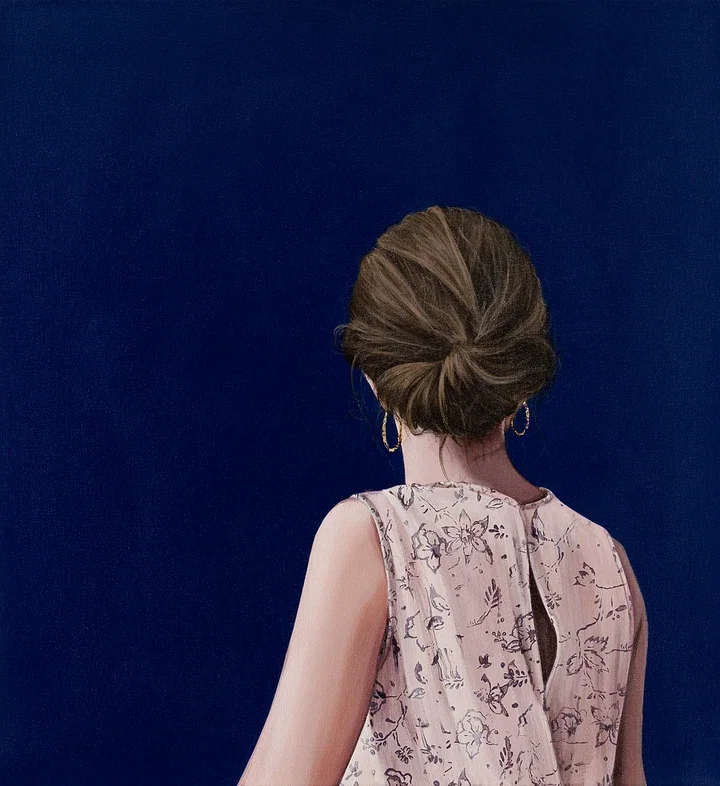
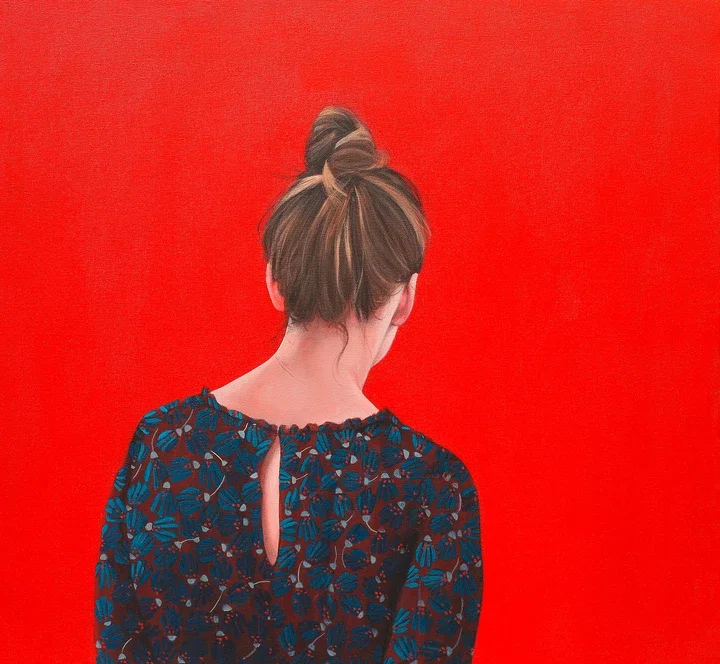
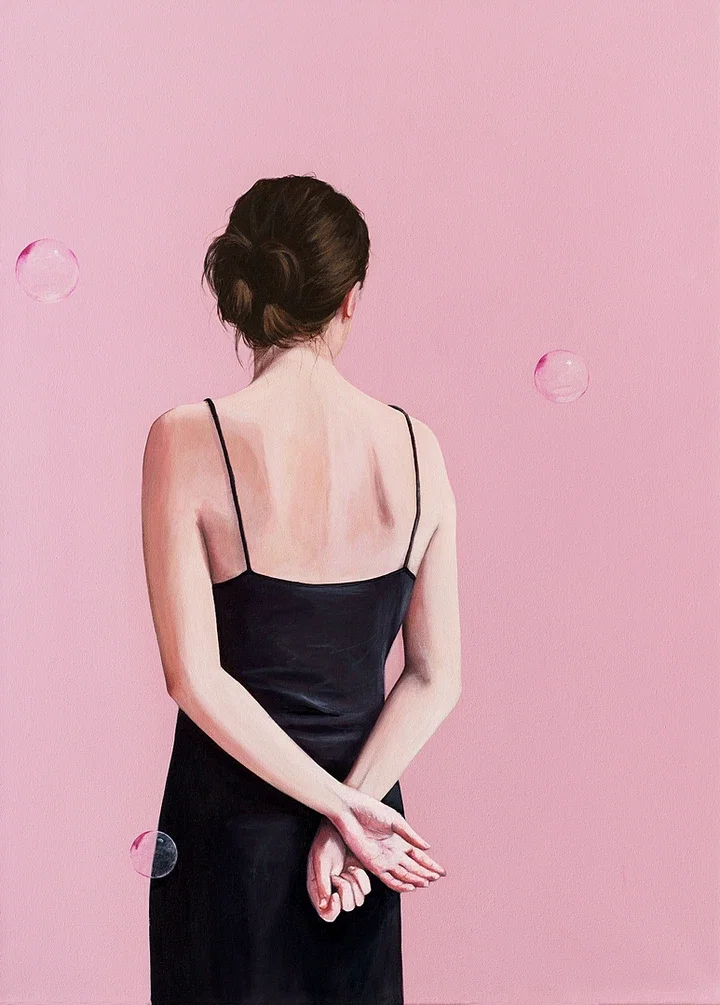
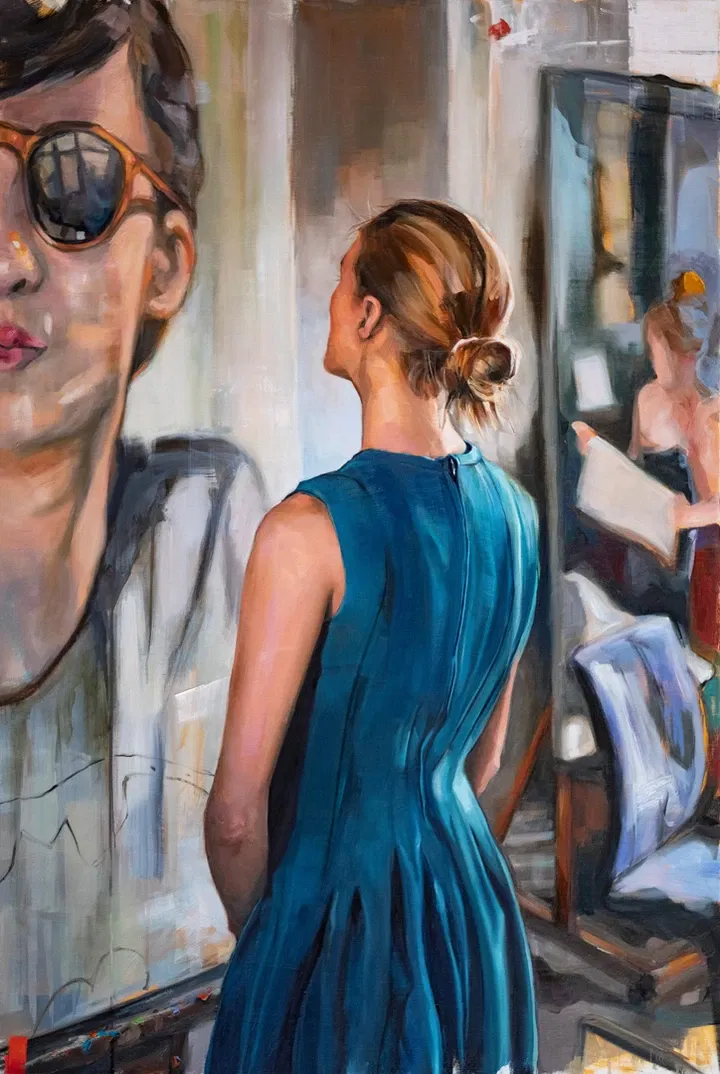
Quiet moments and minimalist compositions characterise Karoline Kroiß’s paintings: women, usually turned away from the viewer, appear against clear expanses of colour and, through their restrained body language, create space for the viewer’s own thoughts and feelings. Drawing on her own photographs, the Berlin-based artist removes her figures from their everyday surroundings and focuses the viewer’s attention on the essential – on posture, colour and the quiet moment of being at one with oneself.
BACKGROUND INFORMATION
They avoid direct confrontation and, precisely through this, create a space of intimacy. Her figures, mostly female, tilt their heads, pause, or focus their attention on something beyond our field of vision. It is not grand gestures that define her pictures. Rather, it is those casual moments in which, outwardly, almost nothing happens, yet inwardly, so much becomes possible. It is not the face, but the posture that conveys the expression. A bowed head, the slight turn of a shoulder, a hand in motion – these are enough for Kroiß to evoke a mood. Her figures appear focused and, at the same time, distant. By eschewing facial expressions and a clear narrative, Kroiß deliberately leaves her images open to interpretation. What eludes the gaze leaves room for the imagination: the viewer can observe without having to follow a predetermined story – and can bring their own memories, feelings and thoughts into the scene. The starting point for these quiet pictorial spaces is the close observation of everyday life. Snapshots form the basis: Kroiß photographs women in unremarkable moments and senses those subtle movements and postures which, on closer inspection, suddenly reveal a particular intensity. In her studio, she removes the figure from its original setting. Rooms, other people and anything that might distract from the essential disappear. What remains is the figure against a reduced coloured surface. Kroiß strips her figures of their context in order to give them scope for interpretation. Kroiß develops the colour scheme in direct dialogue with the image and during the painting process. Clothing and patterns are altered; Kroiß develops backgrounds in relation to the figure; contrasts create accents without disrupting the tranquillity of the composition. The multi-layered application of acrylic paint, sometimes using glazing techniques, creates subtle transitions and a surface that contrasts the formal reduction with painterly depth. Thus, the backgrounds are never mere emptiness. They become atmospheric spaces in which the figures seem to be suspended. Sometimes something else is added: soap bubbles float across the surface, ribbons criss-cross the picture, butterflies accompany a figure. These elements do not explain the scene; they expand upon it. The transience of a soap bubble or the delicate line of a ribbon become visual echoes of those fleeting states that Kroiß captures – moments that seem precious precisely because they cannot be held onto. Elsewhere, too, the artist gently blurs the boundary between reality and pictorial space: patterns may detach themselves from items of clothing, or lines may take on a life of their own. The everyday remains recognisable, yet for a moment is thrown out of its familiar order. Even her earlier works demonstrate this subtle interplay of reality, poetry and gentle disorientation. Her figures remain in an in-between state of tranquillity and detachment, where withdrawal does not necessarily mean solitude, and silence does not mean emptiness. Her figures turn away, but her paintings do not: Karoline Kroiß does not show what is going on inside them – she creates the space in which the invisible can become visible.
VITA
Karoline Kroiß was born in 1975 in Kollerschlag, Austria, and has lived in Berlin since her early childhood. She studied Fine Art at the Berlin University of the Arts, where she completed her master’s degree under Prof. Dieter Hacker. Among other honours, she has been awarded the Dorothea Konwiarz Scholarship and the Walter Hellenthal Prize for Painting; from 2007 to 2015, she received a studio grant from the Berlin Senate. Her works have been exhibited in numerous solo and group exhibitions in Germany and internationally.
Exhibitions
2026
Landschaften, Raab Galerie, Berlin
2024
Fleurs Fiore Flowers, Raab Galerie, Berlin
2023
45 Jahre Artes, Kunsthaus Artes, Berlin
2022
ECCE HOMO, Kunsthaus Artes, Berlin
2021
Affordable Art Fair Hamburg
2020
Miniaturen, de Kunst Salon, Utrecht/Niederlande
Solo Exhibitions
2025
Wenn man am wenigsten damit rechnet, Raab Galerie, Berlin
2024
Beyond Symbols, Kunsthaus Artes, Berlin
INTERVIEW
Picasso once said, “you don’t make art, you find it.” Where do you find your art? On closer inspection. Often, what makes something special is not the subject itself, but the way we engage with it. My photographs arise from such moments of attention.
From an idea to its materialization: How do you approach your work? It all starts with a photograph. In the studio, I strip away everything that distracts from the essential: backgrounds, other figures, and so on. As I work on the figure, I also decide on the colours for the background. I often alter the colours and patterns of the clothing as well. A contrast between the figure and the background colour is also important to me. Depending on the figure’s posture, I sometimes add elements such as soap bubbles, butterflies or ribbons, which have symbolic meaning for me.
What is your favorite book? I don’t have a single favourite book.
Which artist would you like to have coffee with and what would you discuss? With Edward Hopper. I’d be interested to know whether his paintings really depict loneliness or rather moments when people are completely at one with themselves.
How did you get into art? I can’t pinpoint a single moment or trigger. I enjoy creating beautiful things, and somehow I ended up doing that through painting, amongst other things.
Who are the people in your surroundings that influence you? People who go through life with an open mind. Meaningful conversations and everyday encounters often inspire me more than extraordinary events.
Imagine you have a time machine. Where would you go? More into the past than into the future. Perhaps not so far away after all. But the possibilities are too vast for me. I’d rather stay where I am.
Other than art, what are you most passionate about? Anything I can do with my hands that produces a direct, tangible result. This ranges from knitting, sewing and pottery to refurbishing or building furniture myself, right through to home renovations.
What are you working on right now? At the moment I’m painting landscapes. They’re turning out quite differently from my portraits.
LUMAS ART NEWS
Exclusive offers
Inspiring new releases
Personal invitations to Art Events
LUMAS protects your data. See our Privacy Policy for details.
ALMOST DONE ...
1. Open the confirmation mail.
2. Click on the confirmation link.
3. Your wishlist registration was successful!
4. Your wishlist has been saved!
We look forward to welcoming you soon to the world of LUMAS.
DIGITAL PREVIEW
SCAN THE QR CODE! (Safari IPHONE ONLY)
PREVIEW ON YOUR WALL
SCAN THE QR CODE! (Safari IPHONE ONLY)
90% of our customers order mounting or framing for a perfect gallery look.
Fully protected by our 30 day return policy.
Ready to Hang.
Elevates the artwork to true gallery quality.
Continue without mounting or framing?
* Rolled prints are final sale and cannot be returned or retrofitted with our frames
PREVIEW ON
YOUR WALL
SAFARI ONLY. ABOUT 3 METERS DISTANCE.
PRESS START.




 About Karoline KroissThey avoid direct confrontation and, precisely through this, create a space of intimacy. Her figures, mostly female, tilt their heads, pause, or focus their attention on something beyond our field of vision. It is not grand gestures that…
