Introduction
Marina Abramović is one of the most influential artists of our time. Since the 1970s, she has decisively shaped performance art and made her own body her central medium. Internationally, her name stands for an art form that is not merely viewed but experienced on an existential level. How strong her appeal remains to this day is also evident in the current crowds at her Berlin exhibition Balkan Erotic Epic at the Gropius Bau, which once again has mobilized a broad audience far beyond the traditional art world.
What distinguishes Marina Abramović from many other artists of her generation is the consistency with which she explores physical and psychological limits. Early on, she became known for works that are still legendary today: in Rhythm 0 from 1974, she stood motionless in Naples for six hours, making herself available to the audience and offering 72 objects, including knives, a whip, a gun, and a bullet. Visitors were allowed to do whatever they wished to her—an artwork of shocking radicality about power, aggression, responsibility, and the vulnerability of the body.
Equally famous became Rest Energy from 1980, her collaboration with Ulay: both hold a drawn bow, its arrow pointing directly at Abramović’s heart. Just a few minutes of this performance are enough to make an extreme tension, trust, and danger palpable. Abramović herself described Rhythm 0 and Rest Energy as two of the most difficult works of her life, as in both situations she was no longer fully in control.
There are also works such as Imponderabilia, in which visitors had to pass through a narrow corridor between two naked bodies, or Lips of Thomas, an equally physically and symbolically charged performance in which biographical, political, and religious layers condense. And with Balkan Baroque, the work for which she was awarded the Golden Lion at the Venice Biennale in 1997, Abramović ultimately created a piece of haunting force about violence, memory, and historical guilt.
By the time of The Artist Is Present at the Museum of Modern Art in New York, Abramović had also become an icon for a global mass audience. For this work, she sat silently across from visitors for over 700 hours during the exhibition, transforming pure presence into an intense, often deeply emotional experience. This reduction to gaze, duration, silence, and encounter exemplifies what Abramović’s work has consistently been about: attention, devotion, discipline, and the immense emotional power of radical simplicity.
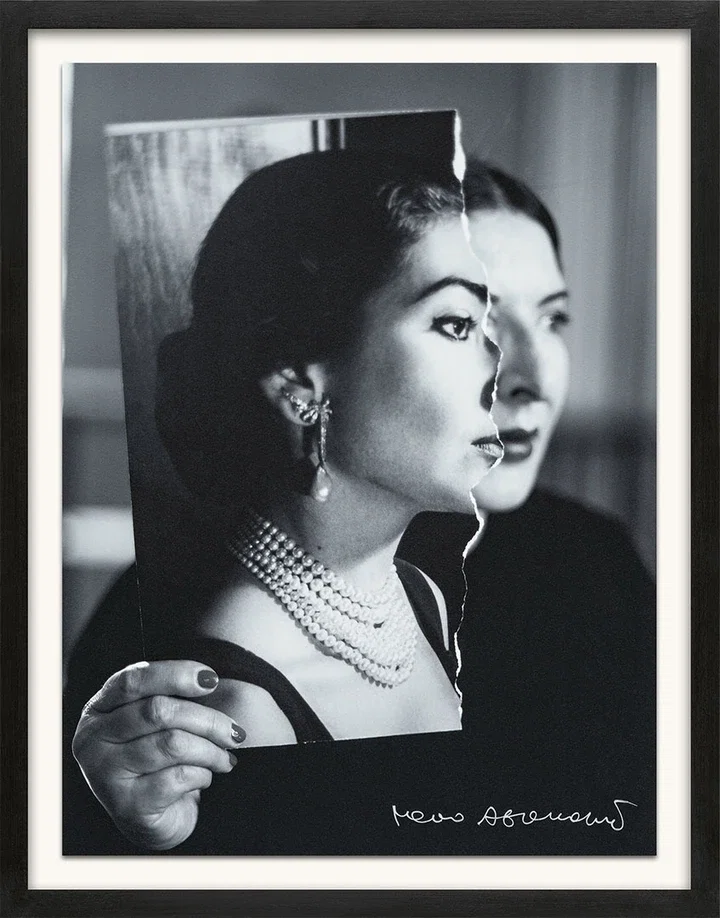
The edition Maria/Marina brings central strands of this extraordinary oeuvre together in a particularly accessible way. The work is a homage to the opera icon Maria Callas, with whom Abramović has felt a deep connection since childhood. In the image, the artist holds a portrait of Callas in front of her face in such a way that both profiles merge into a single appearance. Two icons become one face, admiration becomes identification, memory becomes a quiet yet powerful image of artistic closeness, projection, and self-construction.
This is precisely where the special quality of this edition lies: it translates Abramović’s often extreme, physically demanding work into a concentrated image of great calm and depth. The black-and-white aesthetic lends the motif timeless clarity, while the torn and reassembled image form generates a psychological tension that reaches far beyond portraiture. Maria/Marina is not loud, but highly charged—a work with true presence that fills a space with cultural gravitas, emotional intensity, and great elegance.
At the same time, the edition opens an ideal entry point into Abramović’s work as a whole. For Maria Callas is far more than an admired singer to her: Abramović even dedicated an entire opera project to her with 7 Deaths of Maria Callas. Maria/Marina condenses this long-standing engagement into an image that feels both intimate and iconic. For collectors, this edition is therefore much more than a portrait: it is a powerful statement about devotion, identity, feminine greatness, and the transformative power of artistic self-reinvention.
Bio
Marina Abramović is a Serbian performance artist born in 1946 in Belgrade, and she is considered one of the most important figures in performance art worldwide. She studied at the Academy of Fine Arts in Belgrade from 1965 to 1970 and continued her education at the Academy of Fine Arts in Zagreb from 1972 to 1976.
Since the 1970s, her work has focused on performance art, placing the human body, endurance, pain, and presence at its core. She also explores the relationship between artist and audience, as well as forms of spiritual and meditative experience within art.
Abramović gained international recognition with early key works such as Rhythm 0 (1974), in which she completely surrendered herself to the audience, as well as through her collaboration with the artist Ulay between 1975 and 1988. Together, they developed significant performances such as Rest Energy and The Lovers, which intensely explore trust, relationships, and physical boundary experiences. Other important works from this period include Imponderabilia (1977) and the symbolic conclusion of their collaboration with The Great Wall Walk in 1988.
In 1997, she was awarded the Golden Lion at the Venice Biennale for her work Balkan Baroque, a powerful exploration of violence, memory, and historical guilt. Another major highlight of her career was The Artist Is Present in 2010 at the Museum of Modern Art in New York, where she sat in silence for over 700 hours, interacting with visitors and gaining worldwide recognition.
In addition to her artistic practice, Abramović is also active on an institutional level. She founded the Marina Abramović Institute (MAI), which is dedicated to developing long-duration performance and consciousness-based work, as well as teaching the so-called “Abramović Method.” To this day, she continues to work internationally on performances, exhibitions, and projects that explore presence, perception, and collective experience.
Awards
| 2025 | Praemium Imperiale – Japan Art Association, Tokio |
| 2023 | Sonning Prize – Universität Kopenhagen, Kopenhagen |
| 2022 | Commander, Ordre des Arts et des Lettres – Frankreich |
| 2021 | Princess of Asturias Award for the Arts – Oviedo / Spanien |
| 2021 | Golden Medal for Merits – Republik Serbien |
| 2013 | Officer, Ordre des Arts et des Lettres – Frankreich |
| 2011 | Honorary Royal Academician – Royal Academy, London |
| 2008 | Austrian Decoration of Honor for Science and Art – Österreich |
| 2005 | Best Exhibition of Time-Based Art – United States Art Critics Association, New York |
| 1997 | Goldener Löwe – La Biennale di Venezia, Venedig |
Exhibitions
Solo Exhibitions
| 2026 | Marina Abramović: Transforming Energy – Gallerie dell’Accademia, Venice |
| 2026 | Marina Abramović: Balkan Erotic Epic. The Exhibition – Gropius Bau, Berlin |
| 2026 | Marina Abramović: Seven Deaths – Frederiksbergmuseerne / Cisternerne, Copenhagen/Frederiksberg |
| 2026 | Balkan Erotic Epic – Gran Teatre del Liceu, Barcelona |
| 2025 | ART VITAL – 12 Years of Ulay / Marina Abramović – Cukrarna Gallery, Ljubljana |
| 2025 | Marina Abramović – Galleri F15, Moss |
| 2025 | Balkan Erotic Epic – Factory International, Manchester |
| 2025 | Marina Abramović – Albertina Modern, Vienna |
| 2025 | Marina Abramović: Thomas Lips 1975 – Galerie Krinzinger, Vienna |
| 2025 | Counting the Rice – Centre Pompidou-Metz, Metz |
| 2024 | Marina Abramović: Transforming Energy – The Modern Art Museum (MAM) Shanghai, Shanghai |
| 2024 | Healing Frequency – Moco Museum London, London |
| 2024 | Between Breath and Fire – gres art, Bergamo |
| 2024 | GENERATOR – Usina de Arte, Pernambuco |
| 2024 | Marina Abramović – Kunsthaus Zürich, Zurich |
| 2024 | Marina Abramović – Stedelijk Museum, Amsterdam |
| 2023 | Marina Abramović – Royal Academy of Arts, London |
| 2023 | Energy Clothes – Galerie Krinzinger, Vienna |
| 2023 | 7 Deaths of Maria Callas – London Coliseum, London |
| 2022 | Marina Abramović: Gates and Portals – Modern Art Oxford, Oxford |
| 2021 | Marina Abramović: That Self / Our Self – Kunsthalle Tübingen, Tübingen |
| 2020 | Akış / Flux – Sakıp Sabancı Museum, Istanbul |
| 2019 | The Cleaner – Museum of Contemporary Art Belgrade, Belgrad |
| 2017 | The Cleaner – Moderna Museet, Stockholm |
| 2015 | Private Archaeology – Museum of Old and New Art (MONA), Berriedale/Hobart |
| 2015 | Marina Abramović: In Residence – Pier 2/3, Sydney |
| 2014 | 512 Hours – Serpentine Gallery, London |
| 2010 | The Artist Is Present – Museum of Modern Art, New York |
| 2005 | Marina Abramović – Solomon R. Guggenheim Museum, New York |
Group Exhibitions
| 2025 | Kochi-Muziris Biennale – Kochi/Kerala |
| 2025 | Stillness in the storm – Museum Voorlinden, Wassenaar |
| 2025 | A conversation without words – Musée Jenisch Vevey, Vevey |
| 2025 | Bounding Histories. Whispering Tales – Art Encounters Biennial, Timișoara |
| 2025 | Freeing the Voices – Kunsthaus Graz, Graz |
| 2024 | Invisible Luggage – The Historic Hampton House, Miami |
| 2024 | Opening Fresh Window. The Art of Display & Display of Art – Museum Tinguely, Basel |
| 2024 | The Spirits of Maritime Crossing – Palazzo Smith Mangilli Valmarana, Venice |
| 2023 | Extreme Tension. Art between Politics and Society: Collection of the Nationalgalerie 1945–2000 – Neue Nationalgalerie, Berlin |
| 2004 | Whitney Biennial – New York |
| 1997 | La Biennale di Venezia – Venice |
| 1992 | documenta IX – Kassel |
| 1982 | documenta 7 – Kassel |
| 1977 | documenta 6 – Kassel |
| 1976 | La Biennale di Venezia – Venice |