Daniel Richter is without doubt one of the most important German artists of his generation. In the 1990s, he studied at the Hamburg University of Fine Arts under Werner Büttner and worked as an assistant to Albert Oehlen — both associated with the so-called “Junge Wilde”, who advocated a return to painting in the 1980s.
Richter initially worked exclusively in abstraction before increasingly turning to figurative subjects around the turn of the millennium. His aesthetic influences and themes are diverse. In his painting, he frequently reflects on contemporary events, combining expressive and informational elements. Narrative yet enigmatic, his pictorial worlds at times recall Edvard Munch or Francis Bacon while remaining unmistakably rooted in the present.
He translates the media images of our time into monumental compositions charged with allegorical density and sombre tension. His paintings can at times be read as echoes of history painting, both contemporarily recontextualising and deconstructing the genre.
Like his large-scale, monumentally conceived paintings, Richter’s lithographs are distinguished by their fluid transitions between figuration and abstraction. The shadowy quality of the figures and the ambiguity of the scenes create a dreamlike atmosphere whose indeterminacy leaves room for association.
The thermal-imaging aesthetic often associated with Daniel Richter’s work becomes particularly apparent in the work “Kaschmir”. Shadowy, deep-red human figures — perhaps soldiers carrying rifles — cross a landscape. Their outlines are accompanied by yellow lines — a kind of aura that recalls images produced by an infrared camera.
It is these ambivalently dramatic scenes, situated somewhere between dream, fable, and current events, that make Richter’s artistic signature so unmistakable. Subtly charged with political meaning through title and subject matter, his images remain so diffuse and enigmatic that they resist any linear interpretation and instead stimulate the viewer’s imagination precisely through their ambiguity.
These works have the ability to unsettle us, even when we cannot fully grasp the reason in rational terms. The artist plays with the media-induced images lodged in the minds of viewers; we believe we recognise something familiar, yet at the same time it appears distorted and strange — uncanny in the Freudian sense.
DANIEL RICHTER: THE IDYLL TIPS
There are images that show us something. And there are images that make us watch ourselves seeing. Daniel Richter paints the latter.
Born in Eutin in 1962, the artist is one of the defining voices of German painting of his generation. He moved from the abstraction of the 1990s towards figuration — without ever fully separating the two. Both remain in constant negotiation within his work. Colour is the true protagonist, even when bodies appear and surfaces become scenes.
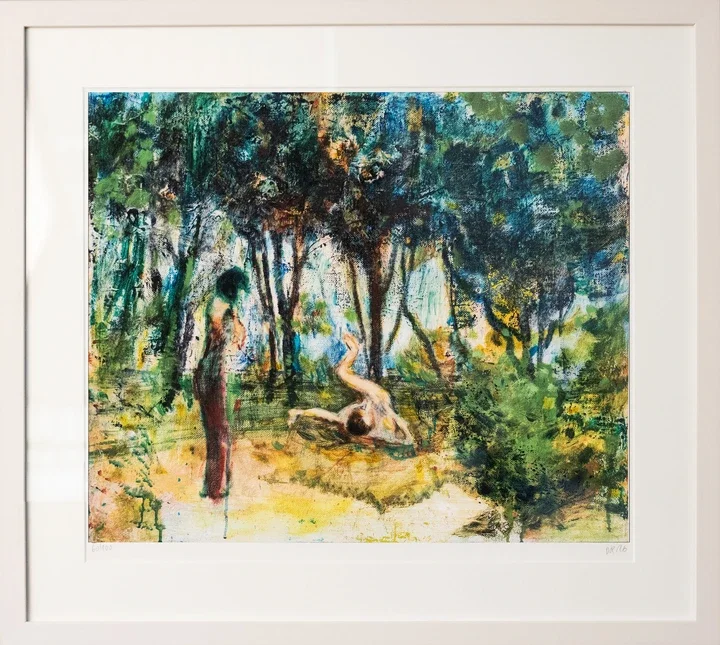
Untitled (2026) lays this principle bare with almost clinical precision. At first, we encounter a forest clearing: almost Impressionistic, nearly soothing. One could be deceived by it. One is meant to be deceived.
A figure dressed in red approaches from the left; at the centre is a naked man, twisted, with his legs raised above his head — a pose that resists any single category: neither acrobatics, nor grotesque, nor pure intimacy, but an overlap of all three.
The naked body in nature has, since the Renaissance, functioned as a code for beauty, desire, and innocence. Richter shifts that code. The body is male, its action directed towards itself. In doing so, not only the figure becomes the object of observation, but our own gaze as well. Voyeurism does not begin within the image, but at the moment when we want to look more closely.
A second temporal axis emerges where painting itself becomes a source: as early as Halber Akt (2013), Richter depicted a masturbating man in a forest — a work that refers to Werner Büttner’s Selbstbildnis im Kino onanierend (1980). In 2026, the motif returns, now as a reference to Richter’s own visual memory.
Formally, too, nothing remains quite what it seems: the forest is both landscape and painting, the body both figure and abstract form. The image therefore shows not only a scene, but also how meaning emerges from colour, figure, and learned habits of seeing.
The idyll tips — and suddenly we are not merely looking at the image. The image exposes us in the act of looking.