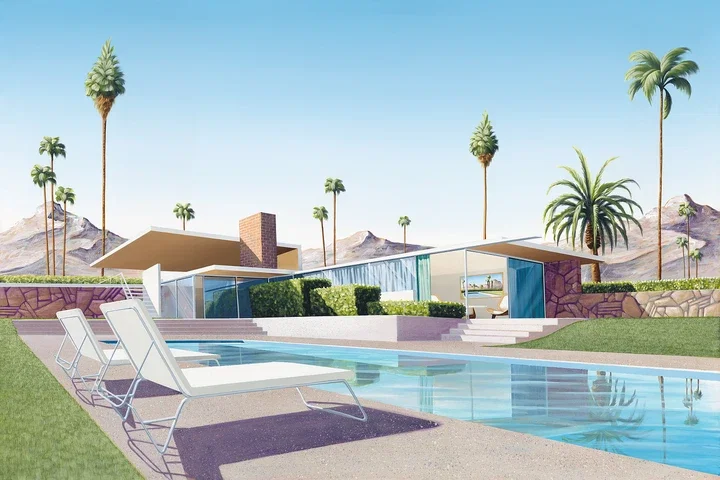
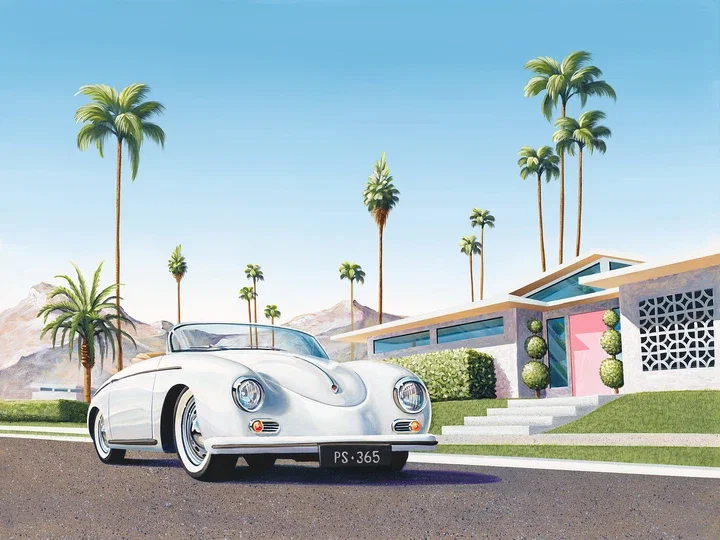
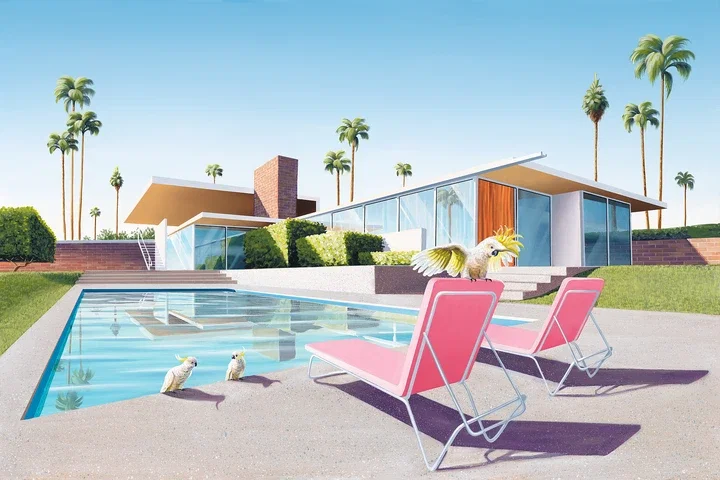
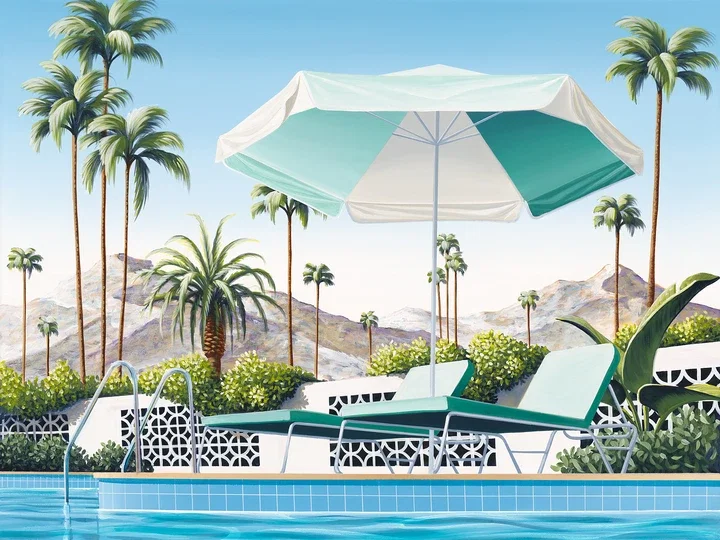
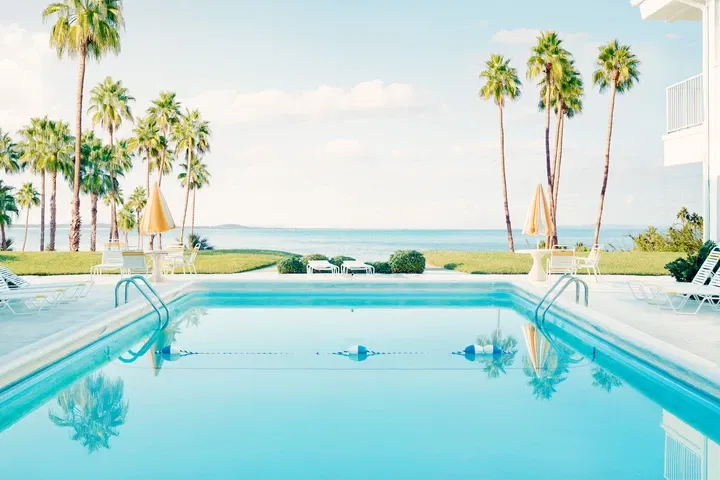
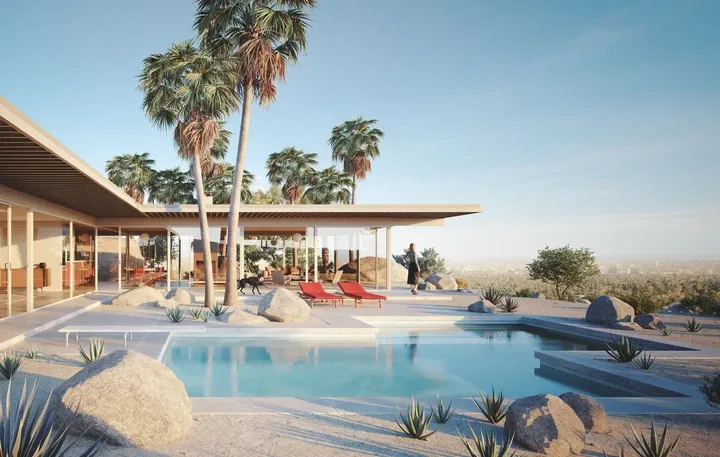
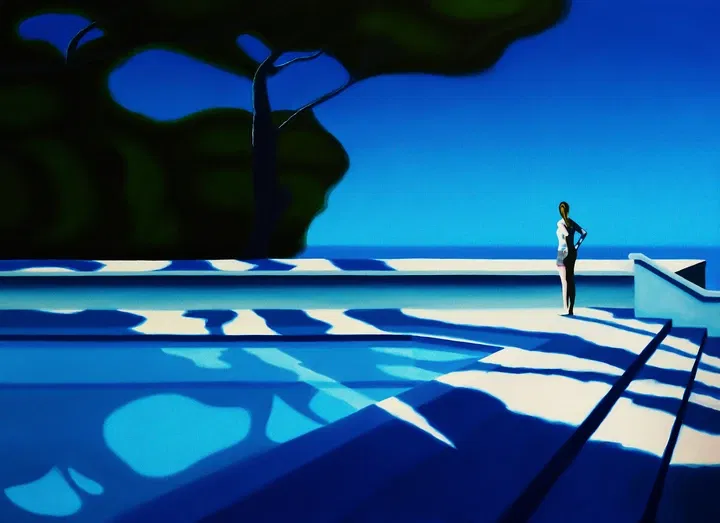
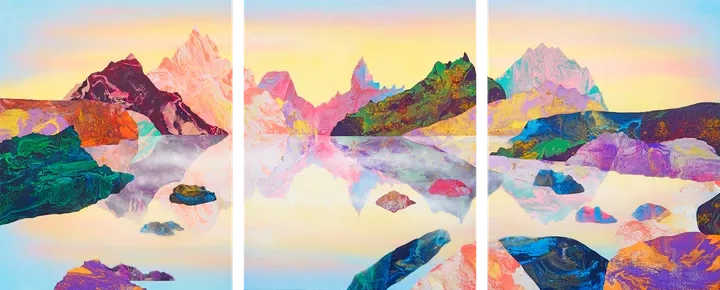
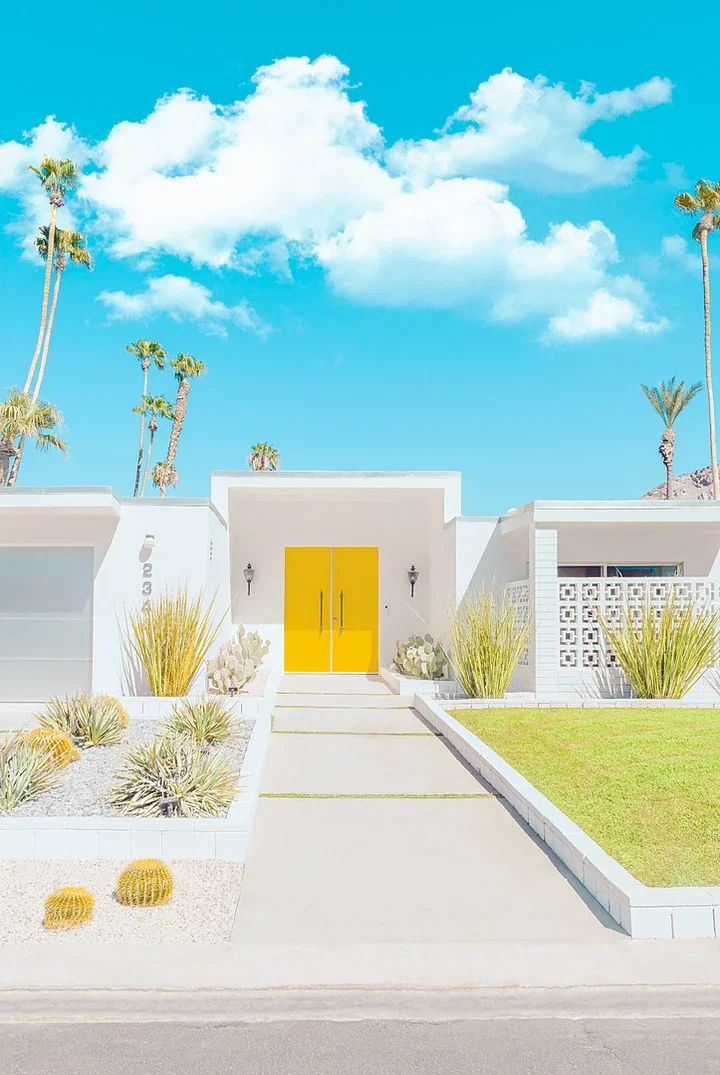
Chris Riley does not paint the world as it is, but as it might feel if we chose to focus on what is beautiful. Beneath his expansive, almost cloudless skies, pools, palm trees, classic cars and light-filled architecture coalesce into a world apart from the everyday: familiar enough to stir memories, idealized enough to embody a vision of what could be. It is within this space between reality and imagination that the Australian artist has developed his distinctive visual language – and a universe he calls “Blue Sky World.”
His paintings follow an inner geography of their own. The sky often forms their fixed point: a luminous blue fading into white, giving the compositions an unmistakable sense of openness. Beneath it, swimming pools and inflatable floats lie at rest, palms rise against crisp architecture, and classic cars appear almost sculptural in the light. Yet for all their precision, these scenes never feel static. A quiet sense of life runs through them, suspended in that elusive calm of a perfect afternoon when, for a moment, nothing seems more pressing than the moment itself.
The sun-drenched Mid-Century aesthetic of Southern California, and Palm Springs in particular, provides Riley with an important visual reference. Yet the Australian roots of his imagery remain visible throughout. Native birds appear among pools, palms and modernist architecture like small geographical signatures, linking Californian images of desire with the artist’s own surroundings on the Gold Coast.
Riley works primarily in acrylic, building his paintings from transparent layers of color. The speed of the medium suits the immediacy of his approach. A simple sketch is laid directly onto the canvas, followed by a concentrated painting process in which he rarely makes fundamental revisions. Layer by layer, precise, almost otherworldly surfaces emerge – evoking reality without reproducing it. His background in the automotive industry quietly resonates in this visual language: in his sensitivity to immaculate surfaces, curves and reflections, as well as in the controlled precision of his process.
What interests Riley, however, is not perfection for perfection’s sake. His idealized scenes revolve around a more fundamental question: What do we choose to direct our attention toward? “What we repeatedly place our attention on becomes the world we believe we live in,” as the artist puts it. For Riley, attention is not a passive act of perception, but a force that helps shape reality itself. In a present where urgency, alarm and deficiency continually push themselves to the foreground, he consciously offers other images. Not to turn away from difficulty, but to make visible what exists alongside it – and what is all too easily overlooked.
In his body of work “The Good Life,” this principle takes on a particularly distilled form. Titles such as “Easy Living,” “Good Company,” “Endless Summer” and “Freedom” describe states of being more than specific scenes. Riley does not paint freedom as an abstract concept; he translates it into space. Togetherness is not expressed as a grand gesture, but as an atmosphere. Summer is defined not by the calendar, but by light, color and the apparent timelessness of a moment. Nostalgia, in Riley’s work, is not a longing to return to a supposedly better past. Instead, it becomes material for imagining how the present might feel. His works do not promise “the good life” through possessions or excess. Their visual restraint suggests something else entirely: that what matters may lie in open skies, in being together, in play and in rest – in moments whose value does not depend on their productivity.
Riley’s handwritten messages distill this outlook even further. “Sometimes play is more important” or “Beauty is everywhere – look up” read almost like keys to his work. They make explicit what his paintings have long suggested: that play has a value of its own, and that beauty does not always need to be created – sometimes it simply needs to be noticed. It is fitting, then, that “Blue Sky World” is now expanding beyond the two-dimensional canvas. Riley is extending his practice into sculpture, immersive exhibitions and storytelling. His first immersive exhibition, “PLAY,” was realized in March 2026 at his studio on the Gold Coast. From recurring motifs, a coherent universe is gradually taking shape: not merely an aesthetic setting, but a space for a particular way of looking at the world.
Chris Riley does not create a place of longing we need to escape to. Instead, his art redirects our attention toward what is already there. Perhaps that is precisely where his form of escapism begins, at the point where escapism usually ends: not by looking into the distance, but by looking more closely at what surrounds us.
Chris Riley is a contemporary Australian artist who lives and works on the Gold Coast. His artistic career began in 2017 in an unusually direct way: while looking for an artwork for the first home he shared with his wife, he decided to paint one himself. Her response – that he should become an artist – became the starting point for the path that followed.
A self-taught artist, Riley has largely represented himself from the outset, presenting his work in his own studio and gallery spaces as well as at the Affordable Art Fair and The Other Art Fair in Australia. Today, his practice extends beyond painting to sculpture and immersive exhibition formats, through which he continues to expand his artistic universe, “Blue Sky World.”
Picasso once said, “you don’t make art, you find it.” Where do you find your art?
Picasso also said that “art should be created in the presence of god” I believe that he was referring to the idea that great art comes from somewhere else, through you. I also believe in this. That what I paint and how I paint it comes from somewhere so deep it is hard to identify exactly where that is.
From an idea to its materialization: How do you approach your work?
The idea is always the same… create something that make others feel better. And for me anything under a vast blue sky makes me feel better. The final result is always very clear in my mind. I do a basic sketch straight to canvas and them paint from start to finish. I very rarely make any mistakes or changes as I go. Once paint hits the canvas it sort of just all falls into place (as if an act of god… or something else)
What is your favorite book?
I had problems with speech as a child and have never been very literate. For that reason I have not read any books besides harry potter (the school made me read it) I do however listen to podcast when ever I paint and I love listening to Seth Godin, so one of his books would most likely be my favourite if I were to read them.
Which artist would you like to have coffee with and what would you discuss?
Salvador Dali. He said that his paintings are of his hypnagogic hallucinations. (The crazy visions that occur in some people when drifting off to sleep) I would love to discus his method to capture those images. I am one of those people who have hypnagogic hallucinations but I have tried to capture them but them but the moment I try to pay attention to them they disappear like smoke.
How did you get into art?
I didn’t really get into art until 2017. My wife and I were shopping for a picture to hang in our first apartment, we couldn’t find anything we liked. I had never been to a gallery. We were looking at furniture shops (no wonder we didn’t like anything) my solution was to go to the local art supply store and paint something myself. Her response to the artwork I create was “you should quit your job and be an artist” so that’s exactly what I did.
Who are the people in your surroundings that influence you?
I spend the majority of my time at the studio with my wife. So the people that have the most influence on me are the people that I choose to listen to each day. They include Gary Lee, Rory Sutherland and Seth Godin. (Mostly thought leaders in business)
Imagine you have a time machine. Where would you go?
That depends on weather it is a one way ticket. If so then I love listening to podcasts about American history and I feel like I am the sort of person who would have thrived in the times of Edison so I would have to say New Jersey one the late 19th century. If I am able to return to the present then I would love to know whoever the world looks the way I think it will in 30 years. It would be immensely helpful in my decision making now.
Other than art, what are you most passionate about?
That would have to be cars. My career before art was in the automotive industry. I love all things that are beautiful but there is something about the curves and reflective surfaces of some cars that I just find captivating.
What are you working on right now?
My big project at the moment is building the universe that is “blue sky world” through expanding my practice into sculpture, immersive exhibitions and story telling. I recently have come to realise that what we repeatedly pay attention to becomes the world we believe we live in. The problem is that many of us have spent years paying attention to what is broken, urgent and alarming. Eventually, we begin to believe that's all there is. That's what Blue Sky World is… A place that reminds us all that beauty is everywhere, we simply have to look up and notice it.