Unfortunately, this artwork cannot be added to the room view.


Self-Portrait EmbroideryInspired by Andy Warhol’s exploration of self-image, Ai Weiwei translates this principle into the present day, raising questions about identity in an age suspended between… Read more
Bio Exhibitions
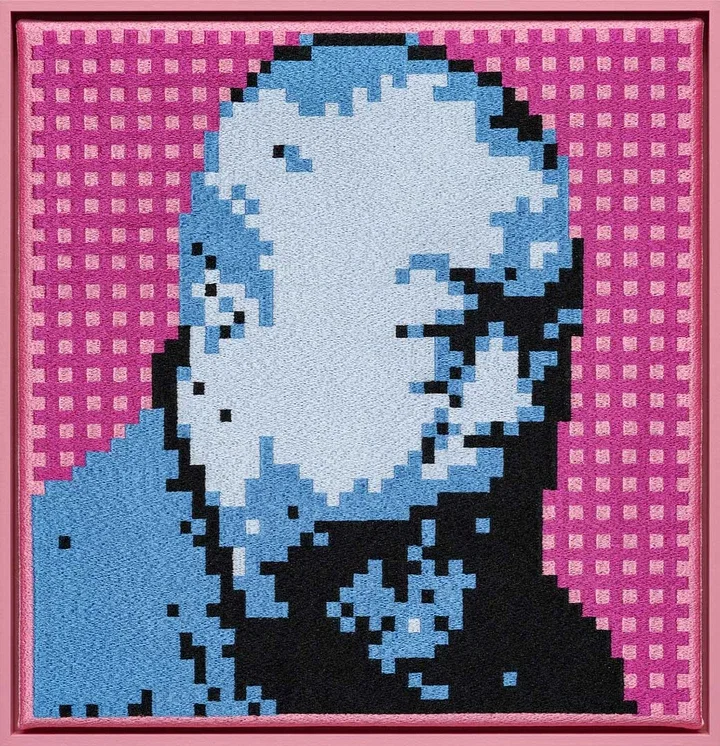
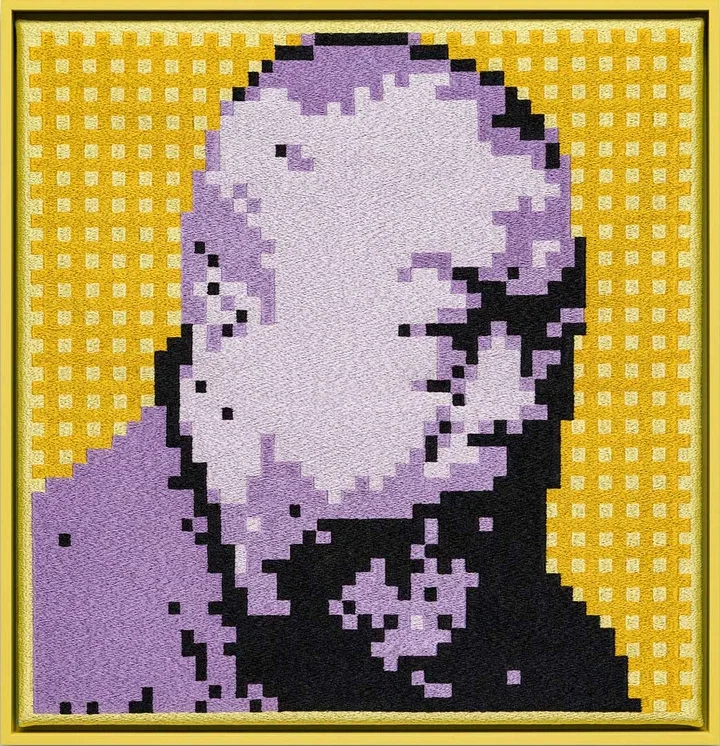
Self-Portrait Embroidery
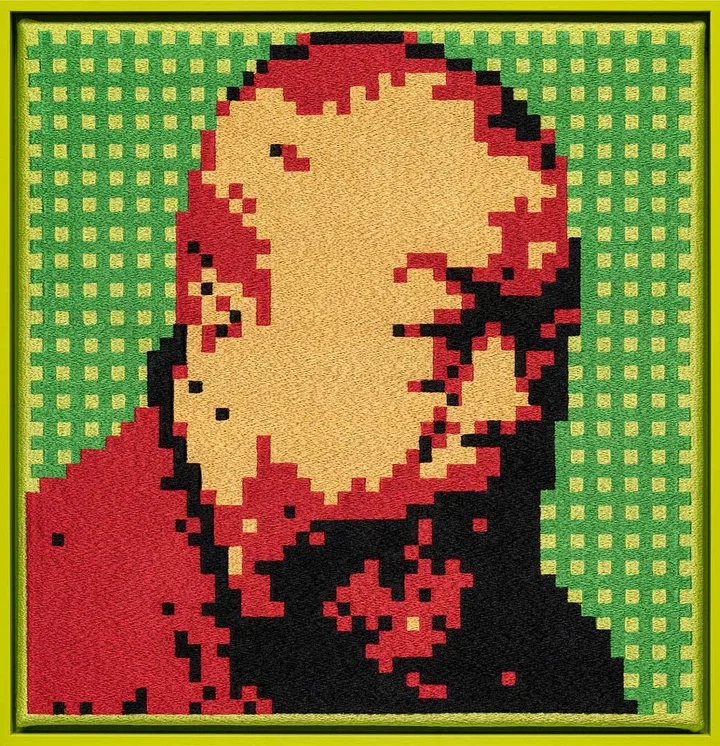
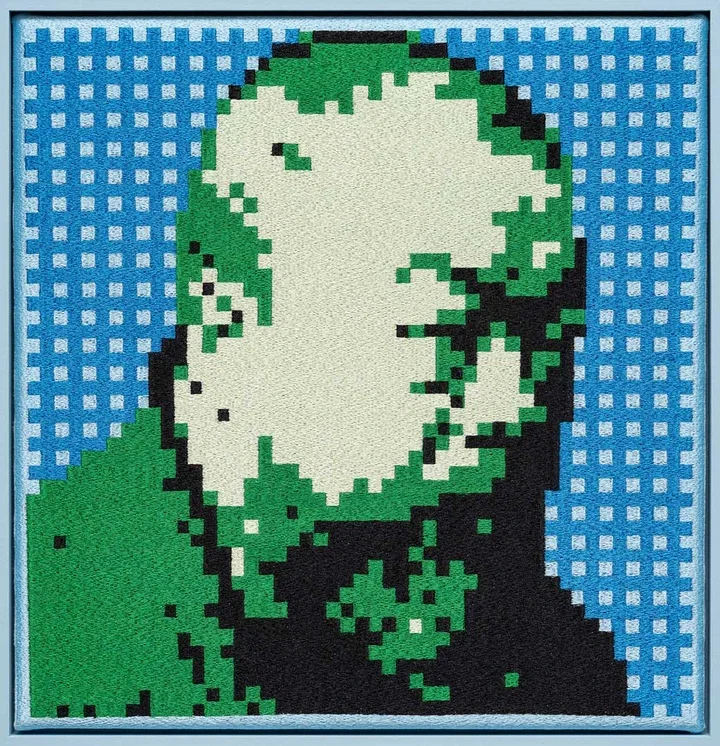
Inspired by Andy Warhol’s exploration of self-image, Ai Weiwei translates this principle into the present day, raising questions about identity in an age suspended between reality and virtuality. Self-Portrait Embroidery already embodies this tension on its surface, with a materiality whose pixel-like appearance evokes digital imagery. The self-portrait thus becomes a site of double translation: from image into material, and from a gesture of resistance into personal presence.
This body of work does not present him as the creator of a symbol, but as its bearer – vulnerable yet unyielding. What was once a motif of resistance is internalized, transformed into a self-portrait of an artist whose biography is inseparable from his stance and artistic language. The starting point is a portrait constructed from toy building blocks, created in the context of his works addressing political imprisonment and solidarity following his 81-day detention. The visible scar refers to state violence linked to his investigations into the Sichuan earthquake, during which he documented the names of over 5,000 deceased schoolchildren.
In the embroidery, this political core is condensed both formally and conceptually: around 460,000 stitches lend the self-portrait a palpable materiality and renewed immediacy. Through varying color palettes, the work marks a precise expansion of his oeuvre: the political dimension remains, yet transforms into a deeply personal presence. A portrait that does not depict resistance, but carries it inscribed within.
Study of perspective
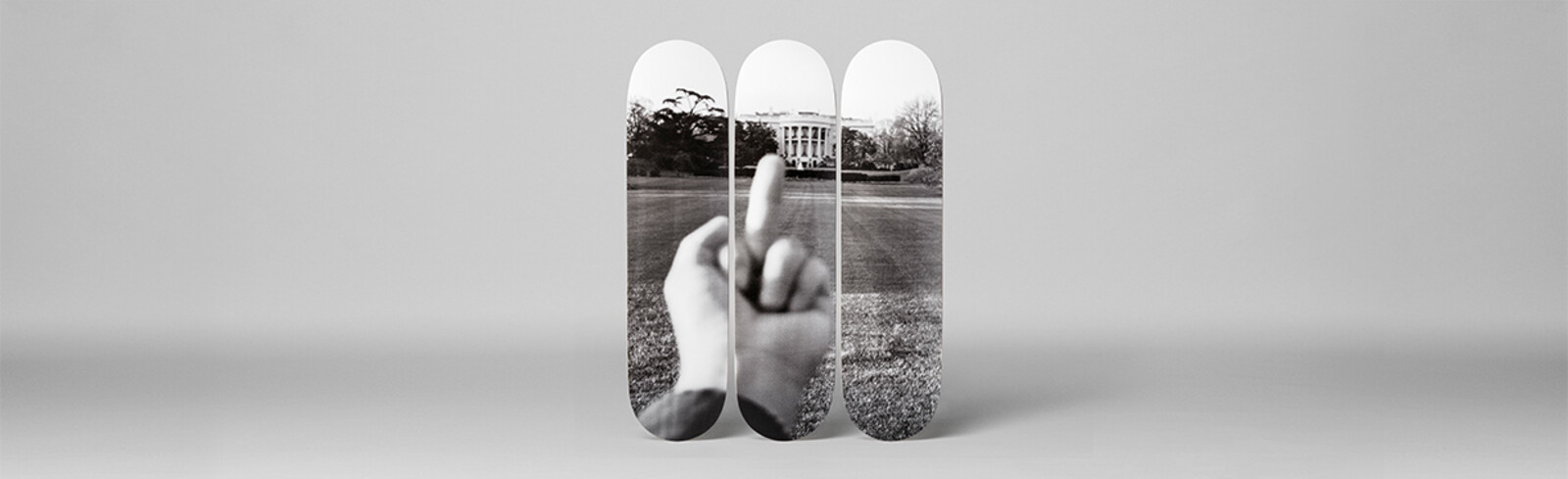
Back in the 1990s, a series of photographs by a then largely unknown Chinese artist caught the public’s eye. The series was entitled Study of Perspective. In the photographs, the artist showed his outstretched middle finger from the picture’s subjective perspective, thus linking the gesture to the symbols of power in the background, such as Beijing’s Tian’anmen Square. The middle finger, used to shift perspective, made Ai Wei Wei famous overnight and has since found numerous imitators. Now as a glass sculpture executed in six colours, his photographic-conceptual device assumes sculptural form. By virtue of their materiality and form, the sculptures liberate themselves from their traditional context, even though the sign remains in the form of a quotation. Thus, depending on colour, the sculpture unleashes new energies. Much like a versatile obelisk of resistance and liberty, the cumulative force of the gesture soars up from the base to emerge as the epitome of opposition.
The Papercut Portfolio
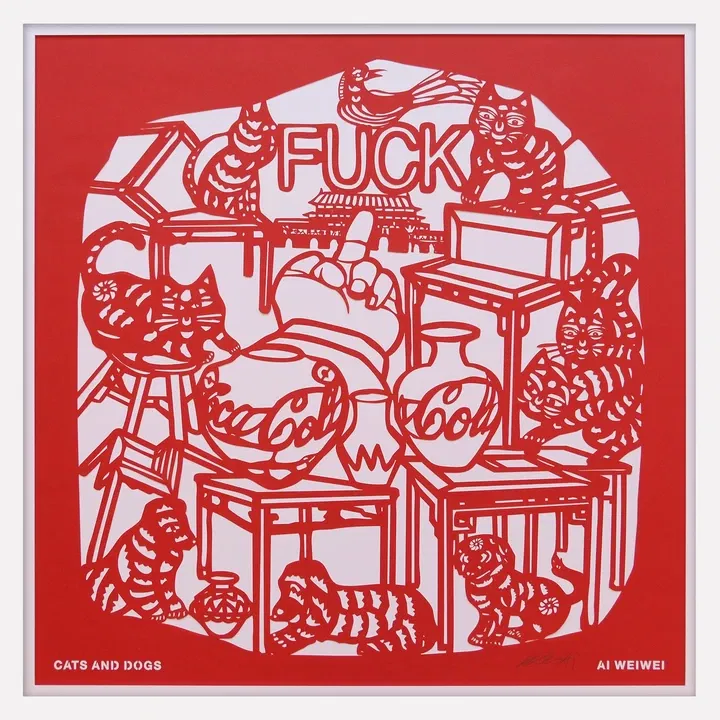
In his project The Papercut Portfolio Ai Weiwei blurs the lines between the political and the personal. Within the series he reflects upon his Chinese homeland, American culture, and his personal phases as an international artist. In eight artworks he captures different stages of his life and career. Including moments such as his time in New York, where he transitioned from a painter to a conceptual artist that would later achieve world recognition, his protest directed at the political establishment in Beijing in the form of a middle finger, and the wooden tower, his contribution to the 12th Documenta in Kassel. The series is a miniature retrospective of the last 40 years and a collection of controversial statements that have characterized the artist's creations from the very beginning of his career. It’s diverse, modern, and traditional at the same time.
By using this technique, the artist is continuing the tradition of Chinese paper cutting, an art form steeped in Chinese history and culture. On holidays and festive occasions, papercuts are hung about, not only to decorate houses but also in remembrance of important moments in history. The are no limits to the motifs that are depicted, they can be anything from plants, to animals, to mythological beings, to scenes from theatre, or simply ornamental. Paper cuttings have been traced back to the 4th century. In The Papercut Portofolio Ai Weiwei demonstrates his appreciation for the historic tradition of art making in his home country China, all while retaining his unmistakable flair for new interpretation. This concept links the papercuts with previous work by the artist. After all, Ai Weiwei has a history of creating artworks that reflect upon and reinterpret China’s historical and cultural goods and assets. In 2009, he took Han Dynasty vases, 2000 year old historical artifacts, and painted them in bright, flashy colors, radically modernizing them. And, if you look closely, you’ll realize that these vases can even be seen within The Papercut Portfolio, in works such as Cats and Dogs and Map of China.
Ai Weiwei is among the greats in contemporary art. His work is exhibited in internationally renowned museums and attracts tremendous media attention. He is also active as a film director, author, and curator. His entire oeuvre is characterized by critical dialogue, and his work aims to engage with social processes and spark discussion. For one installation on Berlin's Gendarmenmarkt, he used a myriad of life jackets to draw attention to the perilous journey so many African migrants are undertaking to cross the Mediterranean. He recently published an insightful documentary about the outbreak of the corona virus in the Chinese city of Wuhan. In the late 1970s, Ai Weiwei studied at the Beijing Film Academy and founded a group of artists that eventually rebelled against the state-controlled cultural institutions and experimented with traditional art practices. After spending several years in the United States, during which he explored new art forms, he returned to China in the early 1990s and became increasingly involved in politics. From 2015 to 2019 he lived and worked in Berlin.
| 1957 | born in Beijing, China |
| 1978 | studied at the Beijing Film Academy, Beijing, China |
| 1979 | co-founder of the avant-garde artist group The Stars, Beijing, China |
| 1981 | moved to the United States |
| 1982 | studied at Parsons School of Design, New York, USA |
| 1993 | returned to China |
| 1997 | co-founder of China Art Archives & Warehouse, Beijing, China |
| 2011 | Honorary Royal Academician, Royal Academy of Arts, London, UK |
| 2013 | Appraisers Association of America Award for Excellence in the Arts |
| 2015 | Ambassador of Conscience Award, Amnesty International |
| 2018 | Marina Kellen French Outstanding Contributions to the Arts Award |
| 2019 | Frank Schirrmacher Prize |
| 2023 | Honorary Fellow, Downing College, University of Cambridge, UK |
| 2026 | Aftershock, MAXXI L’Aquila, Italy Ai Weiwei, Nature Morte, New Delhi, India |
| 2025 | Ai, Rebel: The Art and Activism of Ai Weiwei, Seattle Art Museum, Seattle, USA Camouflage, Franklin D. Roosevelt Four Freedoms State Park, New York, USA |
| 2024–2025 | Ai Weiwei. Don Quixote, MUSAC – Museo de Arte Contemporáneo de Castilla y León, León, Spain Ai Weiwei. Who am I?, Palazzo Fava, Bologna, Italy |
| 2023 | Ai Weiwei: Making Sense, Design Museum, London, UK |
| 2022 | In Search of Humanity, Albertina Modern, Vienna, Austria |
| 2021 | Ai Weiwei, National Museum of Modern and Contemporary Art Korea, Seoul, South Korea Intertwine. Pequi Tree, Roots and Human Figures, Serralves Museum, Porto, Portugal Rapture, Cordoaria Nacional, Lisbon, Portugal Trace, Skirball Cultural Center, Los Angeles, USA |
| 2020 | History of Bombs, Imperial War Museum, London, UK Purgatory, Aedes Architecture Forum, Berlin, Germany |
| 2019 | Everything is Art. Everything is Politics, K20/K21, Kunstsammlung Nordrhein-Westfalen, Düsseldorf, Germany Raiz, Centro Cultural Banco do Brasil, Belo Horizonte, Brazil |
| 2018 | Life Cycle, Marciano Art Foundation, Los Angeles, USA Laundromat, Garage Gallery, Fire Station, Doha, Qatar |
| 2017 | Ai Weiwei. D’ailleurs c’est toujours les autres, Musée cantonal des Beaux-Arts, Lausanne, Switzerland On Porcelain, Sakıp Sabancı Museum, Istanbul, Turkey Maybe, Maybe Not, Israel Museum, Jerusalem, Israel Ai Weiwei: Soleil Levant, Kunsthal Charlottenborg, Copenhagen, Denmark |
| 2016 | Ai Weiwei. translocation – transformation, 21er Haus, Vienna, Austria Life Jacket Installation, Konzerthaus am Gendarmenmarkt, Berlin, Germany |
| 2015 | Ai Weiwei, Royal Academy of Arts, London, UK |
| 2014 | Evidence, Martin-Gropius-Bau, Berlin, Germany According to What?, Pérez Art Museum Miami, USA |
| 2012 | Ai Weiwei – Interlacing, Kunsthaus Graz, Graz, Austria |
| 2011 | Circle of Animals / Zodiac Heads: Gold Series, Somerset House, London, UK Dropping the Urn: Ceramic Works, 5000 BC–AD 2010, Victoria and Albert Museum, London, UK Ai Weiwei in New York: Photographs 1983–1993, Martin-Gropius-Bau, Berlin, Germany Ai Weiwei Absent, Taipei Fine Arts Museum, Taipei, Taiwan |
| 2010 | So Sorry, Haus der Kunst, Munich, Germany Sunflower Seeds, Tate Modern, London, UK |
| 2009 | Ai Weiwei: According to What?, Mori Art Museum, Tokyo, Japan |
| 2008 | Under Construction, Sherman Contemporary Art Foundation / Campbelltown Arts Centre, Sydney, Australia Go China: Ai Weiwei, Groninger Museum, Groningen, Netherlands |
| 2004 | Ai Weiwei, Kunsthalle Bern, Bern, Switzerland |
| 1988 | Old Shoes, Safe Sex, Art Waves Gallery, New York, USA |
| 2025 | A Gap in the Clouds, The Heong Gallery, Downing College, Cambridge, UK |
| 2024 | Pop Forever, Tom Wesselmann &…, Fondation Louis Vuitton, Paris, France |
| 2021 | Legacies of Exchange: Chinese Contemporary Art from the Yuz Foundation, Resnick Pavilion, LACMA, Los Angeles, USA Lovely Creatures, Ludwig Forum, Aachen, Germany |
| 2020 | Curators’ Selection. Summer Exhibition 2020, Royal Academy of Arts, London, UK Facing the Collector. The Sigg Collection of Contemporary Art from China, Castello di Rivoli Museo d’Arte Contemporanea, Turin, Italy |
| 2018 | 21st Biennale of Sydney, Sydney, Australia |
| 2017 | Extra Bodies – The Use of the “Other Body” in Contemporary Art, Migros Museum für Gegenwartskunst, Zurich, Switzerland Art and China after 1989: Theater of the World, Solomon R. Guggenheim Museum, New York, USA Yokohama Triennale 2017 – Islands, Constellations & Galapagos, Yokohama, Japan Hansel & Gretel: Jacques Herzog, Pierre de Meuron, Ai Weiwei, Park Avenue Armory, New York, USA |
| 2014 | Genius Loci – Spirit of Place, 14th Venice Architecture Biennale, Venice, Italy |
| 2013 | German Pavilion, 55th Venice Biennale, Venice, Italy |
| 2011 | MMK 1991–2011: 20 Years of Contemporary Art, Museum für Moderne Kunst, Frankfurt am Main, Germany |
| 2010 | 29th São Paulo Biennial, São Paulo, Brazil People Meet in Architecture, 12th Venice Architecture Biennale, Venice, Italy |
| 2008 | Liverpool Biennial International 08: Made Up, Tate Liverpool, Liverpool, UK Out There: Architecture Beyond Building, 11th Venice Architecture Biennale, Venice, Italy |
| 2007 | documenta 12, Kassel, Germany We Are the Future, 2nd Moscow Biennale of Contemporary Art, Art Centre Winzavod, Moscow, Russia |
| 2006 | Mahjong – Contemporary Chinese Art from the Sigg Collection, Kunsthalle Hamburg, Hamburg, Germany Zones of Contact, 15th Biennale of Sydney, Sydney, Australia Territorial. Ai Weiwei and Serge Spitzer, Museum für Moderne Kunst, Frankfurt am Main, Germany Busan Biennale 2006, Busan Museum of Modern Art, Busan, South Korea |
| 2005 | The 2nd Guangzhou Triennial, Guangdong Museum of Art, Guangzhou, China 1st Montpellier Biennial of Chinese Contemporary Art, Montpellier, France |
| 2004 | The 9th International Architecture Exhibition, Venice Architecture Biennale, Venice, Italy |
| 2002 | The 1st Guangzhou Triennial: Reinterpretation – A Decade of Experimental Chinese Art (1990–2000), Guangdong Museum of Art, Guangzhou, China |
| 1999 | 48th Venice Biennale: dAPERTutto, Venice, Italy |
| 1996 | Encounters with China, Ludwig Forum für Internationale Kunst, Aachen, Germany |
| 1993 | Chinese Contemporary Art – The Stars 15 Years, Tokyo Gallery, Tokyo, Japan |
| 1989 | The Stars: Ten Years, Hanart Gallery, Hong Kong / Taipei |
| 1987 | The Stars at Harvard: Chinese Dissident Art, Fairbank Center for East Asian Research, Harvard University, Cambridge, USA |
| 1979 | The First Stars Exhibition, outside the National Art Museum of China, Beijing, China |