




- Exclusive offers
- Inspiring new releases
- Personal invitations to Art Events


SAFARI ONLY. ABOUT 3 METERS DISTANCE. PRESS START.
 EASTER ART WEEK


READY TO HANG
Out of the box, all LUMAS artworks are ready and easy to hang.

SECURELY PACKAGED
LUMAS works are always packed to the highest standard to make sure it arrives as perfectly as it leaves us.

ARTIST SUPPORTED
Your purchase supports the free and independent work of your favorite artist.

60 DAY RETURNS
Easy 60 day returns to make sure you are satisfied with every purchase.
About Candida HöferCandida Höfer transforms spaces into pictorial spaces. With documentary rigor and conceptual clarity, her photographs offer a view of architecture that is as objective as it is powerful. Since the 1980s, she has created a body of work…Work Info
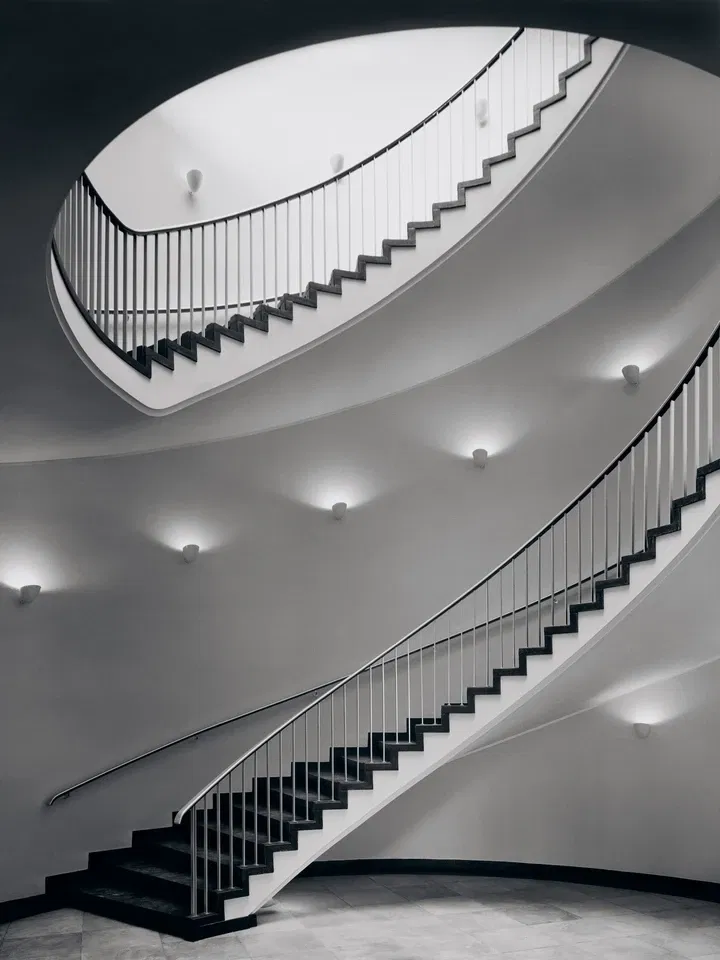
Candida Höfer is an internationally renowned representative of the Düsseldorf Art Academy. She became famous for her large-format, deserted interior photographs of libraries, museums, and opera houses, in which architectural details are staged with formal rigor and symmetry. Her photographs explore how architecture guides, directs, or restrains people, creating a calm, contemplative atmosphere that emphasizes the cultural identity of the spaces.BACKGROUND INFORMATION
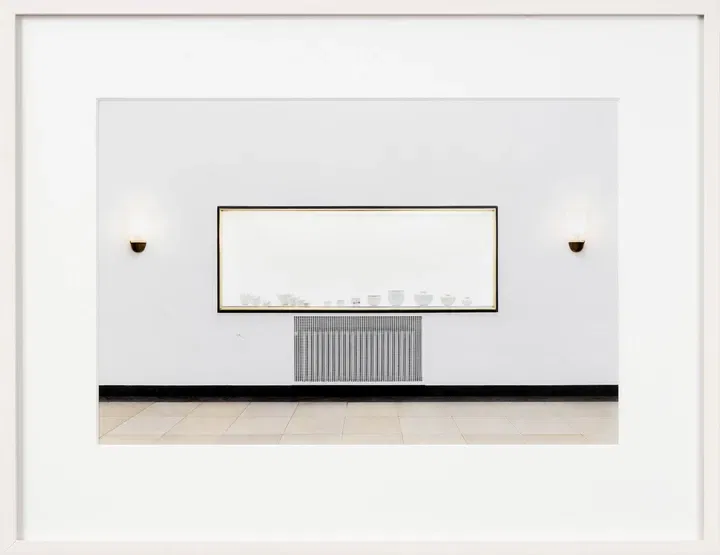
Candida Höfer transforms spaces into pictorial spaces. With documentary rigor and conceptual clarity, her photographs offer a view of architecture that is as objective as it is powerful. Since the 1980s, she has created a body of work that is now considered one of the most influential in contemporary photography. As a student of Bernd and Hilla Becher, she belongs to the legendary “Becher class” of the Düsseldorf Art Academy, which produced an entire generation of artists who revolutionized the understanding of photography as art.Höfer became known for her large-format photographs of public and semi-public spaces—libraries, museums, opera houses—deserted yet full of presence. There is a paradoxical intensity in this absence: spaces become stages for their meaning, architecture becomes narrative. Her controlled composition and precise eye for symmetry and light lend the images a dignity that elevates them beyond mere documentation.Where the Bechers isolated industrial structures against a neutral background, Höfer draws attention to architectural interiors. Unlike her teachers, she makes deliberate use of color—a decision that further enhances the visual presence of her motifs. She uses a large-format camera, which reveals a multitude of details and enables her to create works whose monumental formats were previously reserved for painting. In these dimensions, her works unfold with an almost overwhelming force, in which silence and sublimity merge.This is also how the interior of Hamburg's Elbphilharmonie can be seen – at its center: the longest escalator in Europe at 82 meters, an architectural highlight by Herzog & de Meuron. The gently curved passage, captured by Höfer in flawless symmetry, becomes a resonance chamber of expectation. Similarly, her photograph of the Art History Institute in Bonn shows a display case exhibiting vessels by the world-famous ceramicist Young-Jae Lee. The austerity of the architectural lines meets the organic design language of the vases – a subtle choreography of straight lines and breaks.Höfer's work consistently follows a documentary, objective style: she does not exhibit anything, she does not stage anything, she lets spaces speak for themselves. This is precisely where her artistic signature lies: she gets to the bottom of the character of the supposedly functional and opens it up for meaning and interpretation. Her photographs are portraits of spaces that show more than just architecture—they reflect cultural identity, history, and attitude.Internationally exhibited—for example, at Documenta 11 and the Venice Biennale—she was honored in 2024 with the Käthe Kollwitz Prize, one of the most prestigious German awards for contemporary art. Candida Höfer's photographs not only highlight the significance of a space, but also that of photography itself – thus securing her a new status in the art world.VITA
Candida Höfer was born in Eberswalde in 1944 and lives in Cologne.
She studied at the Düsseldorf Art Academy in the late 1970s and was a master student of Bernd and Hilla Becher.
In 2002, Höfer participated in documenta11 in Kassel, and in 2003 she represented Germany at the 50th Biennale di Venezia alongside Martin Kippenberger (posthumously). She has received numerous awards for her work, including the Käthe Kollwitz Prize in 2024.
Höfer's works are exhibited worldwide and can be found in numerous public and private collections in Germany and abroad.Exhibitions
2022 – Bild und Raum, Museum für Fotografie, Berlin2014-15 – Serie „Memory“ / Russland-Arbeiten, State Hermitage Museum, St. Petersburg2006-07 – Candida Höfer, Le Louvre, Musée du Louvre, Paris2003 – Deutscher Pavillon 50, Venedig Biennale, Venedig2002 – Zwölf – Twelve, Documenta 11, Kassel1999 – Kunsthalle Basel, Basel1993 – Photographie in der deutschen Gegenwartskunst, Museum Ludwig, Köln1993 – Photographie II - Zoologische Gärten, Hamburger Kunsthalle, Hamburg; Kunsthalle Bern

* Rolled prints are final sale and cannot be returned or retrofitted with our frames