


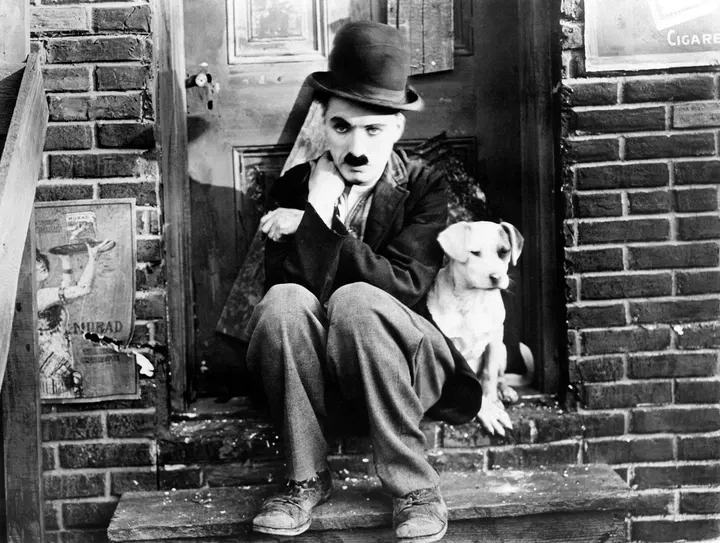
Charlie Chaplin as The Tramp
Classic Collection II
€ 199
Unfortunately, this artwork cannot be added to the room view.


Bring the incomparable Charlie Chaplin into your home in his most famous roles with stylish black-and-white images on your walls! The classic image as a film still from movies like The Gold Rush, City Lights, or Modern Times instantly creates a timeless vintage feel in your home!
The Tramp with his iconic mustache, oversized shoes, and cane is a true Hollywood legend. Chaplin's character of the penniless vagabond is based on his own biography. Born as Charles Spencer in London in 1889, his childhood was marked by bitter poverty, his mother's mental illness, and an absent father. Together with his brother Sydney, Chaplin lived part of his childhood on the streets, in orphanages, and only found stability in theater. As a child and teenager, Chaplin was already performing on stage, singing and acting. His comedic talent quickly shone, and Hollywood took notice of the young Chaplin during a tour of the United States. He developed the Tramp character in 1914 during his time at Keystone Studios. The iconic costume was improvised from mismatched and ill-fitting clothes, emphasizing the humor and poverty of the Tramp character. To this day, this clumsy and lovable slapstick figure remains a role beloved by many and sure to make people laugh. But Chaplin's repertoire also included more serious roles. Unforgettable is his portrayal of Anton Hynkel, The Great Dictator, from the eponymous 1940 satire and anti-war film. Chaplin's incredible talent for film was not limited to acting. He often directed, wrote screenplays, and even composed music for his films.
Chaplin's legacy to the film world lies in his intelligent approach to slapstick, the unmistakable recognition value of the Tramp figure, and his always socially critical commentary on society. The actor, who stood only 1.65 meters tall, was truly one of the greatest of his time!
The most commercially successful and famous actor of his time led a tumultuous private life. He was married four times and had eleven children. Chaplin had numerous affairs, some with underage colleagues. However, his marriage to his wife Oona lasted until the end of his life. The couple had eight children together. The charming screen hero is also said to have shown a less peaceful temperament both privately and professionally.
Chaplin's life story reflects the idea of the American Dream. From extreme poverty, he worked his way up with talent, hard work, and charm to unprecedented wealth in the entertainment industry and is considered one of the co-founders of Hollywood's Dream Factory. In stark contrast, however, is the fact that he was constantly under pressure both privately and politically and was even banned from his adopted home, the USA. His scandalous relationships with underage women, his refusal to fight in World War I, his alleged communist leanings, and his outspoken opposition to Nazi Germany even before the U.S. entered the war made him a target of American politics. The Americans also resented Chaplin for never taking U.S. citizenship. He was only able to return to the U.S. in 1972 with a ten-day visa for the presentation of an honorary Oscar. Chaplin passed away on his estate in Switzerland in December 1977. Looking back, we can see his critical stance toward the U.S., especially during the McCarthy era, his pacifist activism in his films, and his liberal beliefs as very progressive!
| April 16, 1889 | Charles Spencer Chaplin is born in London, England. |
| 1903-1906 | First major theater role as the errand boy Billy in the stage version of Sherlock Holmes. |
| 1908-1913 | Member of Fred Karno's troupe. Chaplin achieves his first successes as a pantomime and comedian. Tours in the USA and Canada follow. Hollywood takes notice of Chaplin. |
| September 25, 1913 | Charlie Chaplin signs a contract with Keystone Studios, where he develops the character of the Tramp. He makes 35 silent films within a year. |
| 1914 | Chaplin moves to Essanay Film Production Company. |
| 1915 | The Tramp is released as his first film with the titular character. |
| 1915-1919 | Moves to Hollywood, California. Chaplin increasingly takes control of his films' direction and screenplay. Contracts with Mutual, and the founding of Chaplin Studios and United Artists with other colleagues help Chaplin gain influence in Hollywood and a considerable fortune. |
| September 23, 1918 | Marriage to 16-year-old Mildred Harris. |
| 1921 | The Kid with Jackie Coogan is released. Coogan becomes one of the first child stars through his role. |
| 1924-1927 | Marriage to Lita Grey, who appeared in several of his films. Their sons Charles Jr. and Sydney Earl are born from this marriage. |
| 1925 | The Gold Rush |
| 1936 | Modern Times |
| 1936-1942 | Marriage to Paulette Goddard, who appeared in Modern Times and The Great Dictator. |
| 1940 | The Great Dictator |
| June 16, 1943 | Marriage to Oona O'Neill. The couple has eight children: Geraldine Leigh, Michael John, Josephine Hannah, Victoria, Eugene Anthony, Jane Cecil, Annette Emily, and Christopher James. |
| 1947 | Monsieur Verdoux |
| 1947-1952 | The FBI starts an investigation against Chaplin, accusing him of communist ties. After filming Limelight, Chaplin moves to Europe with his family. His permission to return to the U.S. is revoked. |
| 1952 | Limelight |
| 1967 | A Countess from Hong Kong with Sophia Loren and Marlon Brando is Chaplin's last and only color film. |
| 1972 | Chaplin receives an honorary Oscar for his lifetime achievements. |
| February 4, 1975 | Queen Elizabeth II. knights Chaplin. |
| December 25, 1977 | Charlie Chaplin dies at his estate in Corsier-sur-Vevey, Switzerland. |
