Introduction
Gerhard Richter, born in Dresden in 1932, is considered one of the most important contemporary artists—and a master of stylistic diversity. Since the 1960s, he has been constantly renewing his work: from photorealistic paintings to blurred images to large-format squeegee abstractions. Where others pursue a single artistic line, Richter makes diversity itself a principle.
One central theme runs like a thread through his oeuvre—spanning more than six decades: the relationship between photography and painting. Richter repeatedly explores the boundary between documentary representation and painterly transformation. By translating photographic material into painting, he blurs the certainties of both media—reality appears in lyrical blurring, abstraction gains representational presence. This productive ambivalence has become the characteristic feature of his work.
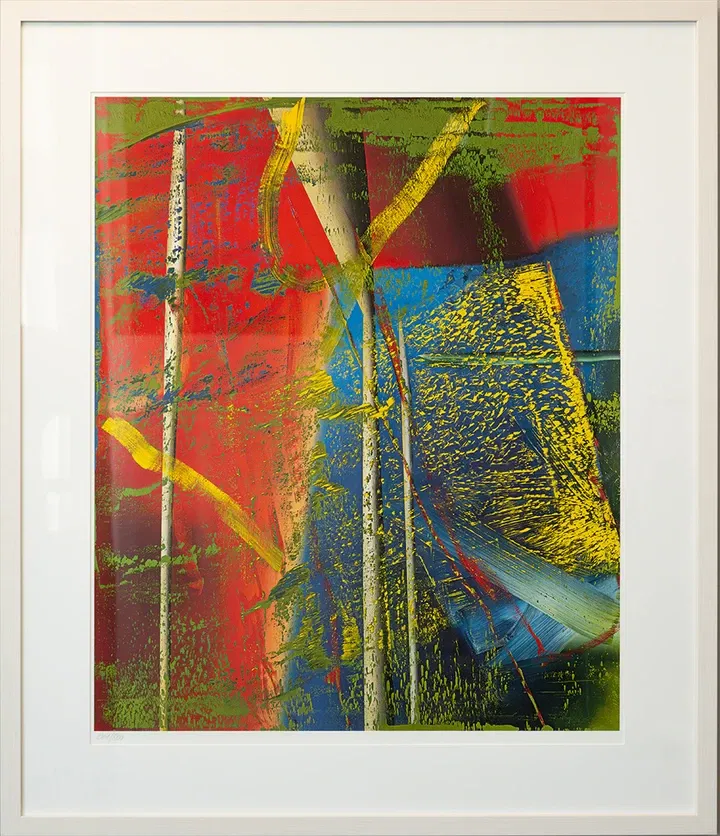
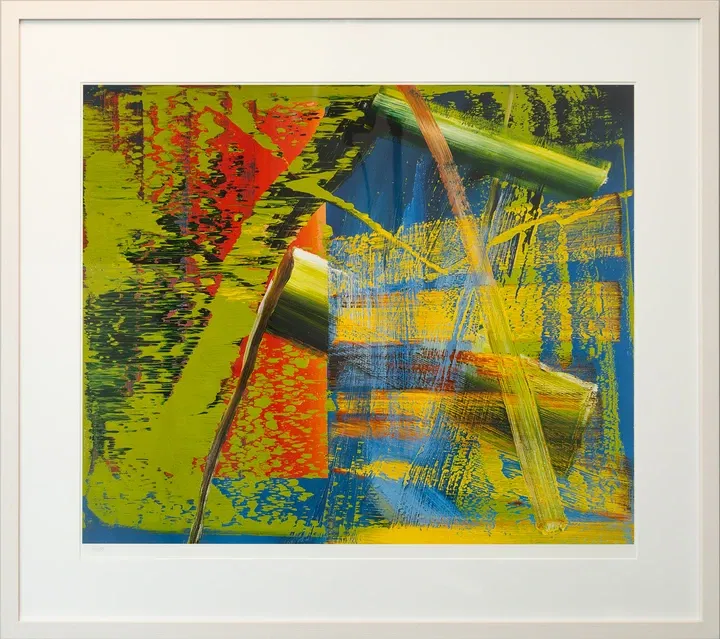
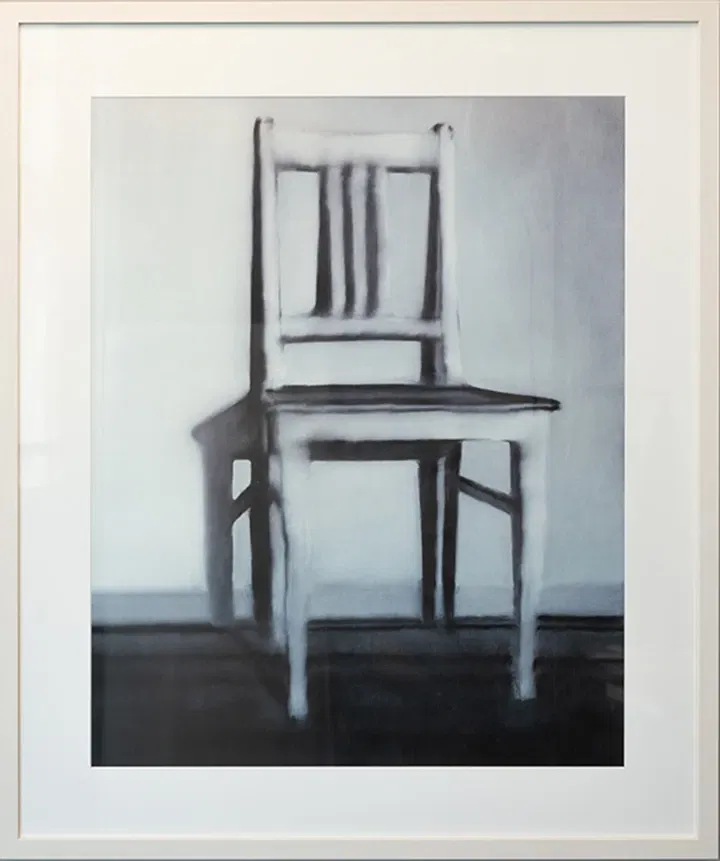
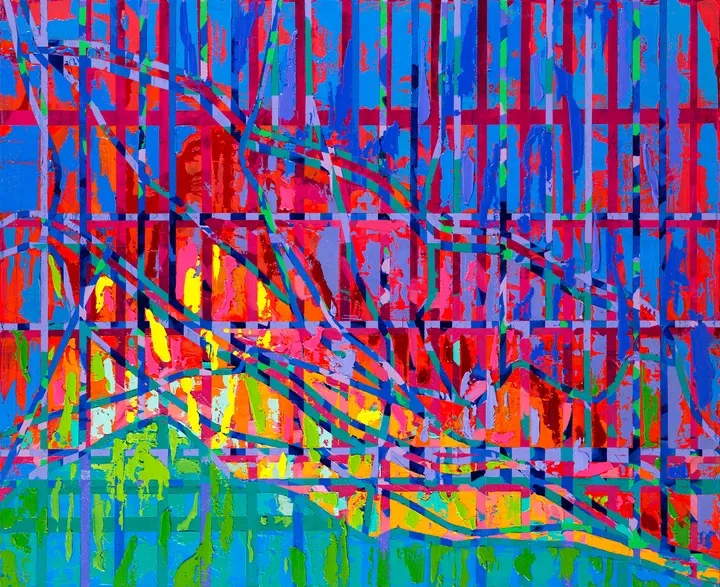
Three works exemplify the breadth of his oeuvre: Juno (1983), now on display at the National Gallery of Australia, is considered a key work of his abstraction, in which the layering and powerful colors of his squeegee technique come to the fore. Abstraktes Bild (1984) achieved an extraordinary auction price at Sotheby's in 1996 – an early indication of Richter's unbroken appeal on the international art market. Küchenstuhl (1965), on the other hand, demonstrates how Richter transforms everyday objects into timeless art, placing them in the field of tension between photography and painting.
Richter's works have long since become cultural reference points – present in major museum collections, celebrated in exhibitions worldwide, and firmly anchored in the discourse of art history. His ability to transform opposites into productive tension lends his work an intellectual depth that is always accompanied by sensual immediacy.
LUMAS is now releasing selected works as limited editions on the finest handmade paper. This is a rare opportunity to add an authentic piece of art history to your own collection and experience the fascination of a century-spanning artist firsthand.
Bio
Gerhard Richter was born in Dresden in 1932 and lives in Cologne. He studied at the Dresden Academy of Fine Arts and later at the Düsseldorf Art Academy, where he also taught as a professor from 1971 onwards. Richter is considered one of the most important contemporary artists and is known for his versatile work, which ranges from photorealism to abstraction. His works are shown worldwide in major museums and at important exhibitions such as documenta and the Venice Biennale, and can be found in numerous renowned collections.
Awards
1997 – Praemium Imperiale, Japan Art Association
1997 – Golden Lion, Venice Biennale
1994 – Wolf Prize in Arts
1986 – Federal Cross of Merit, 1st class
1985 – Oskar-Kokoschka-Prize
Exhibitions
2020 – Gerhard Richter: Painting After All, Metropolitan Museum of Art, New York City2014 – Fondation Beyeler, Riehen
2011-12 – Panorama, Tate Modern, London; Neue Nationalgalerie, Berli
1997 – Venice Biennale, Venice
1980 – Deutscher Pavillion, Venice Biennale, Venice
1972 – Documenta 5, Kassel