









Classic (< 50 cm)
Cabinet (< 80 cm)
Collector (< 120 cm)
Gallery (< 180 cm)
Museum (< 270 cm)
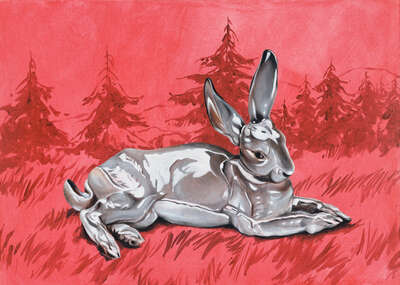
Untitled, 1997
The architectural sculptures by Tadashi Kawamata appear light and seemingly accessible. He tends to cross boundaries between installation art and organic architecture. With his seemingly chaotic wooden objects he rerecords extant buildings or exceeds these with structures that seem to develop lives of their own.
Kawamata's frequent duplications point to a Japanese Shinto ritual of Shukunen Shengu, in which the Ise Temple, a building central to the religion, has been duplicated in every detail every twenty years since the seventh century. The meaning and craft of the building technique is transferred from the older structure to the new building and its creator.
With his very uniquely planned projects, guided by models and drawings, Kawamata moves in a gray zone between destruction and reconstruction, illuminating imitation and playful ritual.
| 1953 | born in Hokkaido, Japan |
| until 1984 | studied Fine Art and Music at Tokyo University, Japan |
| 1977 | first exhibition |
| Since then he took part or undertook a large number of projects and exhibitions in Japan and abroad, including La Biennale di Venezia 1982, Documenta 8 (1987), Sao Paolo International Biennal 1987, Documenta 9 (1992) | |
| 1999-2005 | Professor in Tokyo University of Fine Art and Music, Japan |
| 2005 | Director of the Yokohama Triennale 2005, Japan |